
Sidebar
Table of Contents
Scriptor Magicae
Scriptor Magicae is a Vanilla-style mod adds various kinds of magic spell to the world with the aim of making discovery and spellcrafting simple, interesting, and reasonable when compared to Vanilla gear and capabilities.
In this mod, spells are constructed much like sentences, with a catch:
 The words and sentence structure used are random in every world!
For the average player, plenty of spells can be obtained in each world, but for anyone dedicated enough, you can reverse engineer these spells and learn how to draft even more powerful spells yourself.
For information on usage and such, check out the docs on GitHub or explore the world in game to learn more about how magic works for you.
Craft in-game guidebook Simple Scriptomagy for more information.
Casting
Casting Types
Verbal Casting
You may speak a Spell aloud (in chat) in order to either test it or construct new Spells on the fly.
Casting Spells yourself does come with some advantages and drawbacks which Spellbooks don't carry. When casting a Spell, your throat may be burned by magical residue. For most low-level spells, this won't do much but prevent you from casting more spells verbally. If constructing spells, be careful, however, as cast spells may harm or change you in ways a Spellbook wouldn't. As spells become more expensive, they will drain your hunger and health, potentially even leading to death, so be careful!
Spellbook
 Currently, the foremost handheld tool you will use to cast spells is the Spellbook. Excepting one-off spells and testing, this is generally how most people will use magic.
Spellbooks can be written using a Spellbook and Quill, or converted from a Written Book using a Spellbook Binder,
Spells cast from a spellbook are generally around 70% the cost of the spell when cast verbally, and will have less adverse effects on the user. There is a limit to the maximum power of a spell cast through a spellbook, after which spells will fizzle.
These books will cast any valid spell contained within, and have a shorter cooldown (70% of the duration by default) than spoken spells. In addition, tools such as Spellbooks won't generally negatively affect their user.
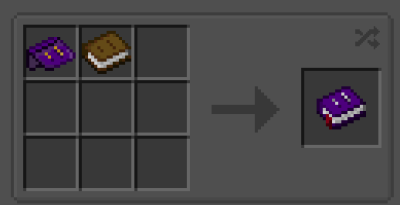
They can be crafted by placing a Spellbook Binder and a Written Book in a Crafting Table.
Obfuscation
You can hide the contents of a Spellbook and prevent it from being crafted back into a regular book by crafting it with a Glow Ink Sac.
Dyeing
Any spellbook that is not already obfuscated can be dyed by crafting it with any vanilla dye.
Scrolls
Scrolls are another, slightly less cost-efficient way to cast spells. They can only be written at a Writing Desk, and can only be used once, but can cast slightly more powerful spells.
You can craft them using one paper, one string, and one copper ingot by default, and they can be written to using the Writing Table.
Artifacts
Artifacts are incredibly rare and powerful casting implements with no upper limit on cost, with the caveat that they cannot be created directly.
You can only find them in loot in certain higher level areas, like Ancient Cities, Bastions, and End Cities.
Casting Lecterns
Casting Lecterns can be used to cast spells without player input. You can place a Spellbook on one by right-clicking on the lectern with a Spellbook in hand, and the lectern will cast in the direction the back of the lectern is facing. Lecterns can not cast spells upwards or downwards.
A Casting Lectern's focus can be modified using a Casting Crystal.
Chalk Circles
Chalk circles are a single-use casting method that allow you to cheaply cast larger spells, but require a bit more setup. Note that despite the name, these aren't always circles!
Chalk will, when right-clicked, attempt to form a spell by proceeding from the right-clicked block to the end of every attached chain of chalk blocks. Chalk circles have ten times the casting capacity of a Lectern. Once cast, all chalk in a chalk circle will disappear.
Chalk is easy to craft, just combine 2 pieces of Calcite
Once crafted, name in an anvil to associate it with a magic word
Cost and Fizzling
Sometimes, a spell cannot be cast as is, for one reason or another. If this happens, when attempting to cast, the spell will Fizzle.
There are two main reasons a spell can fizzle:
- The spell is too costly, or
- A requirement of the spell has not been met
Every component a spell contains can modify the spells cost.
When a spell contains so many components that it exceeds the max cost of
your casting medium, the spell will fizzle.
If a spell fizzles due to its cost, it may be helpful to add cost-reducing components
or remove costly descriptors from the spell.
Components such as reagents or conditions can consume an item to reduce spell cost, while
components that increase spell strength and duration generally increase cost.
Conditions
As mentioned in the previous section, some components introduce conditions to a spell.
The first type are reagent components, which consume an item every time a spell is cast, but greatly reduce cost. These are helpful for preventing powerful spells from fizzling. The second category is more broad. Conditions that require you to be on full health, or will only target specific entities can be very useful for reducing spell cost, but cause the spell to fizzle outright when not met. Legend tells of a word that can be added to any spell that reduces their cost for no price…,
Should such a thing exist, one would wonder why it isn't in every spell?
Complex Spells
Spells can, technically, contain any number of Actions and any number of descriptors on each Action. Now that you've found a complex spell, you can replicate this feat!
Choose a spell with multiple actions and pay attention to 2 things:
- The structure each section follows,
- Whether there are any additional words separating these groups
Thankfully, some assumptions always hold true for complex spells like these.
The Descriptors affecting an action will always be adjacent to the action, for instance, and within each section the Action and Descriptors will be in the same order.
Additionally, actions will always resolve left to right,so if you put an action further left in the spell it will be executed first.
SpellCrafting
Unfortunately, I am limited on how much advice I can give when it comes to writing your own spells. The structure of sentences and the words you need to use to create spells will differ based on the world (server/save) you are in.
I can advise you search out Ancient Tomes, and compare the effects of the spells within in order to learn more about the words that make up Spells in your world. Pay attention to words they may have in common, as well as the placement of specific types of words within them.
If you are having trouble figuring out what a certain spell does, it may be worth using an Identify Scroll on them.
Lastly, if you're doing to be making a lot of spells, it probably behooves you to make a Scriptionary to record your notes and a Writing Desk to do it at.
Ancient Tomes
 Ancient Tomes can be found in libraries in the world, as well as given out by Librarians as a reward for saving villages.
When dusted off (right-clicked), these reveal Books or Spellbooks containing Spells created in times long past.
Identify Scroll
 Identify Scrolls are a unique item which you use from within the inventory. These can be found in numerous loot containers in the Overworld, Nether, and End, or traded from Librarian Villagers with a high trade level.
Use these by picking up the item stack with your mouse and right clicking it onto the Spellbook you'd like to identify. 2 features of the spell will be identified at once, though it may take a few tries to identify all of them.
Scriptionary
The Scriptionary is an item that can be used in conjunction with the Writing Desk in order to research spells and write new ones.
It acts to hold all the words and definitions you record in it through the Desk.
Writing Desk
The Writing Desk is a block that can be used to take down notes and create new spells.
It is most often used in conjunction with the Scriptionary, as well as with Spellbooks and Scrolls.
Actions
Actions, sometimes known as effects among other things, are a required part of any spell.
These components decide what a spell primarily does, with actions that allow starting fires, healing the sick, moving things around, and more!
There must be at least one action in every spell, but there can be numerous if the containing spell is formatted correctly.
| INFLAME | heats or sets the target on fire |
|---|---|
| LIGHT | places a light where it is cast |
| HEAL | heals or repairs the target |
| SMITE | electrifies the target |
| EXPLOSION | creates an explosion on the target |
| GOTO | takes the caster to the target |
| SWAP | switches the position of the caster and target |
| BRING | brings the target to the caster |
| BREAK | breaks down items and blocks |
| DRY | dries up fluids |
| PLACE | places a block |
| CONJURE_WATER | conjures water |
| HARM | harms the target |
| COLOR | changes the target's color |
| TIME | marches the clock forwards |
| CLEAR_WEATHER | The clouds part |
| RAIN | summons a storm |
| BOUND_SWORD | summons an ethereal sword |
| BOUND_AXE | binds magic into an axe |
| BOUND_SHOVEL | coalesces energy into a shovel |
| BOUND_PICKAXE | brings forth a magical pickaxe |
Descriptors
Descriptors, which some know as modifiers, are an optional but powerful component in any spell.
These components can do a very wide array of things, like modifying a spell's strength, changing what a spell targets, and even reducing the cooldown and cost requirements of a spell!
Every Action in a spell can be paired with any amount of Descriptors.
Descriptors are one of the most dynamic parts of a spell;
You can include many in each part of a spell, and they will all contribute in some way.
But some Descriptors don't add exclusive effects.
What if you could use the same Descriptor multiple times?
For instance, maybe two Descriptors consume reagents to reduce cost.
In this case, the effect will simply resolve twice:
Two of the reagent will be consumed, and the cost of the spell will be dropped twice as much.
Sometimes, though, an effect doesn't make sense to resolve twice, like in the case of colors.
I wonder what happens if you add multiple of these to one spell…
| LONG | makes effects last longer |
|---|---|
| LONGER | lasts somewhat longer than usual |
| VERY_LONG | lasts a very long time |
| STACKING_LONG | last slightly longer |
| SLOW | makes it slower than usual |
| FAST | makes it faster than usual |
| CHAIN | reaches out to nearby targets |
| NETHER | The target is changed to a different plane |
| COLLIDE_WITH_WATER | makes the spell able to be cast on fluids |
ColorDescriptors
- WHITE
- LIGHT_GRAY
- DARK_GRAY
- BLACK
- RED
- ORANGE
- YELLOW
- LIME_GREEN
- GREEN
- LIGHT_BLUE
- CYAN
- BLUE
- PURPLE
- MAGENTA
- PINK
- BROWN
- RAINBOW
DiscountDescriptors
Using these descriptors makes the spell cost cheaper
| BLOOD_COST | You feel a brutal efficiency in this spell. It may hurt to use |
|---|---|
| CHEAP | For some reason, this spell costs less than most |
| HEALTHY | This spell demands perfect health |
| POISONED | You must be poisoned to channel this spell |
| WEAKENED | This spell draws from the user's weakness |
| ON_FIRE | This spell's user must be on fire |
| CRITICAL | This spell pulls power from the caster's grave injuries |
| NIGHT | This spell only works under cover of night |
| RAIN | This spell is aided by the falling rain |
| CLEAR_SKIES | This spell won't work in the rain |
InventoryDescriptors
| INVENTORY | targets a target's inventory |
|---|---|
| FIRST_EMPTY | targets the first empty slot in an inventory |
| FIRST_FILLED | targets the first filled slot in an inventory |
| FIRST_MATCHING | targets the first valid slot in an inventory |
| CASTER_INVENTORY | focuses on the caster's inventory |
| CASTER_FIRST_EMPTY | focuses on the first empty slot in the caster's inventory |
| CASTER_FIRST_FILLED | focuses on the first filled slot in the caster's inventory |
| CASTER_FIRST_MATCHING | focuses on the first valid slot in the caster's inventory |
OffsetDescriptors
| MOVE_UP | targets are moved one block up |
|---|---|
| MOVE_RIGHT | targets are moved one block to the right |
| MOVE_LEFT | targets are moved one block to the left |
| MOVE_FORWARDS | targets are moved one block forwards |
| MOVE_DOWN | targets are moved one block down |
| MOVE_BACKWARDS | targets are moved one block backwards |
| COPY_UP | targets are copied over one block up |
| COPY_RIGHT | targets are copied over one block to the right |
| COPY_LEFT | targets are copied over one block to the left |
| COPY_FORWARDS | targets are copied over one block forwards |
| COPY_DOWN | targets are copied over one block down |
| COPY_BACKWARDS | targets are copied over one block backwards |
PowerDescriptors
Makes spells stronger
| BLOOD_POWER | You sense a wicked power in this spell. It may hurt to use |
|---|---|
| STRONG | spell is strengthened somehow |
| POWERFUL | strengthened greatly |
| STACKING_STRONG | slightly strengthened |
| MASSIVE_STRONG | unfathomably strong |
| OVERWHELMING_STRENGTH | The strength of this spell overwhelms the caster |
| SOLAR_POWER | strengthened during the day |
PotionActions
- POISON_POTION
- SLOW_POTION
- REGENERATION_POTION
- WITHER_POTION
- SATURATION_POTION
- SPEED_POTION
- HASTE_POTION
- STRENGTH_POTION
- JUMP_BOOST_POTION
- RESISTANCE_POTION
- FIRE_RESISTANCE_POTION
- WATER_BREATHING_POTION
- NIGHT_VISION_POTION
- WEAKNESS_POTION
- HERO_POTION
- PHASING_POTION
- WILD_PHASING_POTION
Subjects
Subjects are the core of a spell, and define what a spell affects.
These are the only component there can only be one of.
Subject determine targets, such as what a projectile hits, whatever contacts a rune placed on the ground, the first thing the caster can touch, and more.
| SELF | spell targets the caster. |
|---|---|
| TOUCH | targets whatever the caster can touch |
| HITSCAN | targets whatever is in front of the caster |
| PROJECTILE | fires a projectile that casts on hit |
| STORM | cast numerous times around the caster |
| RUNE | places a rune which casts when touched |
| ENCHANT | can be cast on other items in the inventory |
| METEOR | spell falls from above where the caster is looking |


